Enrich
Camel supports the Content Enricher from the EIP patterns .
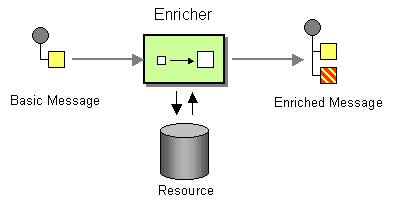
In Camel the Content Enricher can be done in several ways:
-
Using Enrich EIP or Poll Enrich EIP
-
Using a Message Translator
-
Using a Processor with the enrichment programmed in Java
-
Using a Bean EIP with the enrichment programmed in Java
The most natural Camel approach is using Enrich EIP, which comes as two kinds:
-
Enrich EIP: This is the most common content enricher that uses a
Producerto obtain the data. It is usually used for Request Reply messaging, for instance, to invoke an external web service. -
Poll Enrich EIP: Uses a Polling Consumer to obtain the additional data. It is usually used for Event Message messaging, for instance, to read a file or download one using FTP .
| This page documents the Enrich EIP. |
The Enrich eip supports the following options which are listed below.
| Name | Description | Default | Type |
|---|---|---|---|
|
note |
The note for this node. |
String |
|
|
description |
The description for this node. |
String |
|
|
disabled |
Whether to disable this EIP from the route during build time. Once an EIP has been disabled then it cannot be enabled later at runtime. |
false |
Boolean |
|
expression |
Required The expression to compute the endpoint URI to enrich from. |
ExpressionDefinition |
|
|
variableSend |
To use a variable as the source for the message body to send. When using send variable then the message body is taken from this variable instead of the current message, however the headers from the message will still be used as well. |
String |
|
|
variableReceive |
To use a variable to store the received message body (only body, not headers). This makes it handy to use variables for user data and to easily control what data to use for sending and receiving. |
String |
|
|
aggregationStrategy |
Sets the AggregationStrategy to be used to merge the reply from the external service, into a single outgoing message. By default Camel will use the reply from the external service as outgoing message. |
AggregationStrategy |
|
|
aggregationStrategyMethodName |
This option can be used to explicitly declare the method name to use, when using POJOs as the AggregationStrategy. |
String |
|
|
aggregationStrategyMethodAllowNull |
If this option is false then the aggregate method is not used if there was no data to enrich. If this option is true then null values is used as the oldExchange (when no data to enrich), when using POJOs as the AggregationStrategy. |
String |
|
|
aggregateOnException |
If this option is false then the aggregate method is not used if there was an exception thrown while trying to retrieve the data to enrich from the resource. Setting this option to true allows end users to control what to do if there was an exception in the aggregate method. |
false |
Boolean |
|
shareUnitOfWork |
Shares the UnitOfWork with the parent and the resource exchange. Enrich will by default not share unit of work between the parent exchange and the resource exchange. This means the resource exchange has its own individual unit of work. |
false |
Boolean |
|
cacheSize |
Sets the maximum size used by the ProducerCache which is used to cache and reuse producers when uris are reused. Use 0 for default cache size, or -1 to turn cache off. |
Integer |
|
|
ignoreInvalidEndpoint |
Whether to ignore an invalid endpoint URI when trying to create a producer with that endpoint. |
false |
Boolean |
|
allowOptimisedComponents |
Whether to allow components to optimise enricher if they are SendDynamicAware. |
true |
Boolean |
|
autoStartComponents |
Whether to auto startup components when enricher is starting up. |
true |
Boolean |
|
allowedSchemes |
Sets an optional comma-separated allow-list of component schemes that the dynamic recipient may resolve to (e.g. http,https). When set, a dynamic endpoint whose scheme is not in the list is rejected. This is a defence-in-depth restriction, useful for low-code / Kamelet deployments; by default (unset) any scheme is allowed. |
String |
Exchange properties
The Enrich eip supports the following exchange properties which are listed below.
The exchange properties are set on the
Exchange
by the EIP, unless otherwise specified in the description.
This means those properties are available after this EIP has completed processing the
Exchange
.
| Name | Description | Default | Type |
|---|---|---|---|
|
CamelToEndpoint |
Endpoint URI where this Exchange is being sent to. |
String |
Content enrichment using Enrich EIP
Enrich EIP is the most common content enricher that uses a
Producer
to obtain the data.
The content enricher (
enrich
) retrieves additional data from a
resource endpoint
to enrich an incoming message (contained in the
original exchange
).
An
AggregationStrategy
is used to combine the original exchange and the
resource exchange
. The first parameter of the
AggregationStrategy.aggregate(Exchange, Exchange)
method corresponds to the original exchange, the second parameter the resource exchange.
Here’s an example for implementing an
AggregationStrategy
, which merges the two data
as a
String
with colon separator:
public class ExampleAggregationStrategy implements AggregationStrategy {

    public Exchange aggregate(Exchange newExchange, Exchange oldExchange) {
        // this is just an example, for real-world use-cases the
        // aggregation strategy would be specific to the use-case

        if (newExchange == null) {
            return oldExchange;
        }
        Object oldBody = oldExchange.getIn().getBody();
        Object newBody = newExchange.getIn().getBody();
        oldExchange.getIn().setBody(oldBody + ":" + newBody);
        return oldExchange;
    }

}
In the example Camel will call the http endpoint to collect some data, that will then
be merged with the original message using the
AggregationStrategy
:
-
Java
-
XML
-
YAML
AggregationStrategy aggregationStrategy = ...

from("direct:start")
  .enrich("http:remoteserver/foo", aggregationStrategy)
  .to("mock:result");
<route>
<from uri="direct:start"/>
<enrich aggregationStrategy="myStrategy">
<constant>http:remoteserver/foo</constant>
</enrich>
<to uri="mock:result"/>
</route>- route:
from:
uri: direct:start
steps:
- enrich:
expression:
constant: http:remoteserver/foo
aggregationStrategy: "#myStrategy"
- to:
uri: mock:result
- beans:
- name: myStrategy
type: com.foo.ExampleAggregationStrategyAggregation Strategy is optional
The aggregation strategy is optional. If not provided, then Camel will just use the result exchange as the result.
The following example:
-
Java
-
XML
-
YAML
from("direct:start")
  .enrich("http:remoteserver/foo")
  .to("direct:result");
<route>
<from uri="direct:start"/>
<enrich>
<constant>http:remoteserver/foo</constant>
</enrich>
<to uri="mock:result"/>
</route>- route:
from:
uri: direct:start
steps:
- enrich:
expression:
constant: http:remoteserver/foo
- to:
uri: mock:result
Would be the same as using
to
:
-
Java
-
XML
-
YAML
from("direct:start")
  .to("http:remoteserver/foo")
  .to("direct:result");
<route>
<from uri="direct:start"/>
<to uri="http:remoteserver/foo"/>
<to uri="mock:result"/>
</route>- route:
from:
uri: direct:start
steps:
- to:
uri: http:remoteserver/foo
- to:
uri: mock:resultUsing dynamic uris
Both
enrich
and
pollEnrich
supports using dynamic uris computed based on information from the current Exchange. For example, to enrich from a HTTP endpoint where the header with key orderId is used as part of the content-path of the HTTP url:
-
Java
-
XML
-
YAML
from("direct:start")
  .enrich().simple("http:myserver/${header.orderId}/order")
  .to("direct:result");
<route>
<from uri="direct:start"/>
<enrich>
<simple>http:myserver/${header.orderId}/order</simple>
</enrich>
<to uri="direct:result"/>
</route>- route:
from:
uri: direct:start
steps:
- enrich:
expression:
simple:
expression: "http:myserver/${header.orderId}/order"
- to:
uri: mock:result
See the
cacheSize
option for more details on
how much cache
to use depending on how many or few unique endpoints are used.
|
Using out-of-the-box Aggregation Strategies
The
org.apache.camel.builder.AggregationStrategies
is a builder that can
be used for creating commonly used aggregation strategies without having to create a class.
For example, the
ExampleAggregationStrategy
from previously can be built as follows:
AggregationStrategy agg = AggregationStrategies.string(":");
There are many other possibilities with the
AggregationStrategies
builder, and for
more details see the
AggregationStrategies javadoc
.
See More
See Poll Enrich EIP